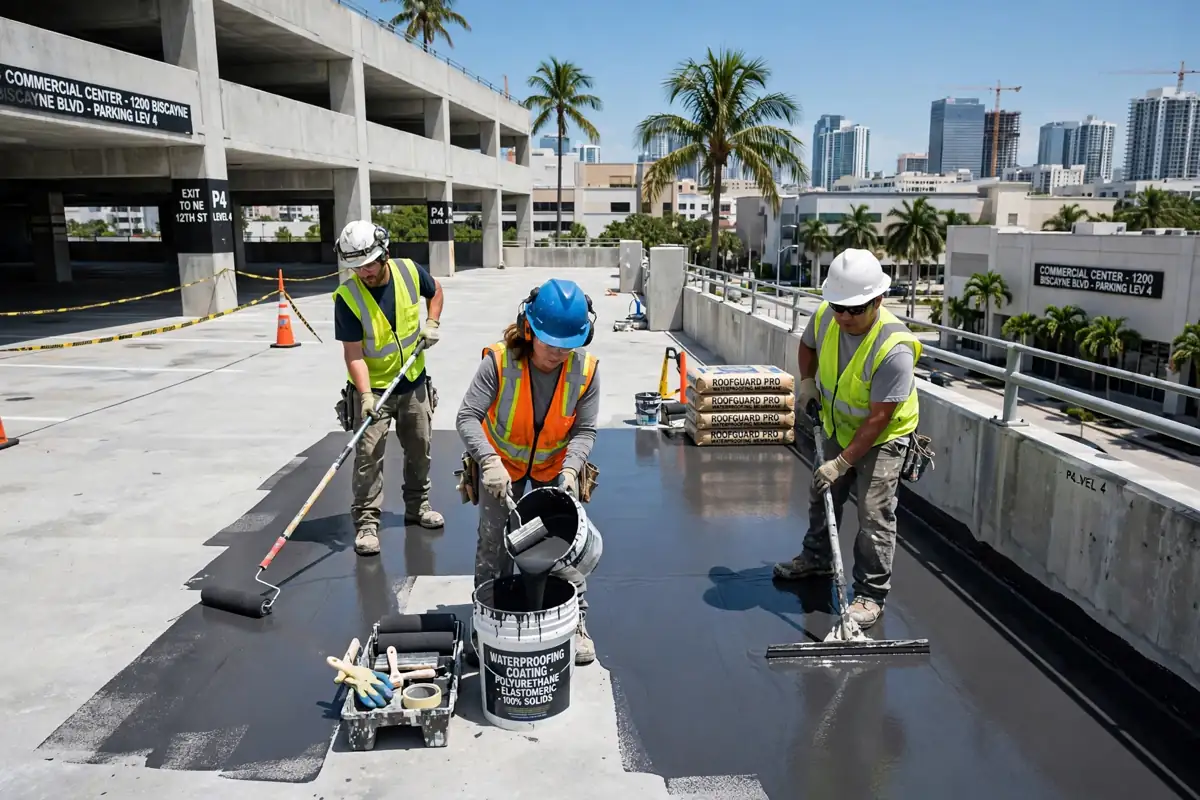
Why parking decks fail from the top down
Water enters a deck through the same short list everywhere: worn or missing traffic coating on the driving surface, failed expansion and construction joint seals, cracks that telegraph through toppings, and drains that pond water against every weakness. In coastal South Florida the water carries chlorides, which accelerate corrosion of the slab's reinforcing steel once it reaches it.
Corrosion is expansive — rusting steel grows and pops the concrete around it, producing the spalls and rust-stained ceilings familiar in older garages from Miami to West Palm Beach. Every year of deferred deck waterproofing converts surface work into structural repair, which is why engineers treat deck programs as asset protection, not cosmetics.
Traffic coating systems, explained plainly
A deck traffic system is a multi-layer waterproof membrane built for vehicle abrasion: primer, a flexible waterproofing base coat, intermediate coats with aggregate for wear and traction, and a UV-stable topcoat — heavier builds on ramps, turn lanes, and helical ramps where tires scrub hardest. The membrane waterproofs the slab while the aggregate layers sacrifice themselves to traffic over years.
System selection follows exposure: top decks need UV-stable finishes, covered levels need moisture-tolerant builds, and occupied space below (retail, residential, storage) raises the waterproofing standard because a leak is no longer dripping on cars. Joints get purpose-built seals and cover systems, not coating stretched across a moving gap — movement joints are where generic deck jobs fail first.
The survey: coating work versus structural work
A deck survey separates three scopes that get conflated in cheap proposals: waterproofing (coatings, joints, drains), concrete repair (spalls, delamination, crack repair), and structural engineering (section loss, post-tension issues, anything affecting capacity). Sounding the slab for delamination and mapping spalls tells you how much of each scope your deck actually needs.
Post-tensioned decks deserve a specific warning: never cut, core, or grind blind on a PT slab. Tendon locations must be scanned before repair work. Any proposal for a post-tension garage that does not mention tendon location is a proposal to stop reading.
Phasing work in an operating garage
Garages rarely close for waterproofing. Work phases by level and bay — typically quarter or half levels at a time — with ramps sequenced to keep circulation open and occupied-space-below areas prioritized in the rainy season. Cure windows and Florida afternoon storms set the daily plan; elastomeric and urethane systems each have moisture and temperature limits the schedule has to respect.
Owners should expect a written phasing plan with the proposal: which levels close when, how fire lanes and accessible spaces are maintained, and how the work interacts with condo milestone or city inspection timelines where those apply. In an operating building, the phasing plan is half the product.
Where decks sit in a reserve and milestone plan
For condominiums and commercial owners alike, deck waterproofing is now a scheduled capital item: milestone inspections examine garages closely, reserve studies fund deck cycles (traffic coatings commonly renew on a 5–10 year horizon depending on traffic and exposure), and insurers price visible structural deterioration.
A documented deck program — survey, phased system installation, joint renewals, and annual inspections — is the file that satisfies engineers and boards, and it costs a fraction of the structural repair bill that arrives when waterproofing is skipped for a decade in a salt-air environment.
Signs this service is the right call
- Water dripping through the deck onto cars or spaces below, especially after rain
- Rust staining, cracking, or concrete spalls on garage ceilings and beams
- Traffic coating worn through to concrete in drive lanes, ramps, and turns
- Expansion joint seals that are split, missing, or patched with incompatible material
- Ponding on deck surfaces and drains that no longer clear
- A milestone inspection, reserve study, or engineer flagging the garage for waterproofing
How the work runs, step by step
- Deck condition survey. Sounding for delamination, spall and joint mapping, drainage review — separating waterproofing scope from structural scope.
- Tendon and utility location (PT decks). Post-tension tendons located and marked before any cutting, coring, or grinding is planned.
- Concrete repairs in scope. Spalls and delamination repaired to sound concrete with corrosion treatment, photographed before coating.
- Traffic system installation. Multi-coat waterproof traffic system with aggregate wear layers, heavier builds at ramps and turns.
- Joint renewal and closeout. Expansion and construction joints sealed with movement-rated systems; phasing records and warranty filed.
Planning costs in South Florida
| Scope | Planning range | Notes |
|---|---|---|
| Traffic coating system | Priced per sq ft | Build weight varies: lanes vs. stalls vs. ramps |
| Joint seal renewal | Priced per linear foot | By joint type and movement rating |
| Deck survey + phasing plan | Priced per structure | Includes delamination sounding map |
Ranges are planning figures from published market data, not quotes. Your number depends on the moisture scan, deck condition, detail count, and access. Get the full breakdown in the commercial roof coating cost guide.
Frequently asked questions
How long does a parking deck traffic coating last?
Traffic systems commonly serve 5–10 years before renewal depending on traffic volume, turning abrasion, and sun exposure, with ramps and turn lanes wearing first. The waterproofing base often outlasts the wear layers, so renewal can be a topcoat cycle rather than a full rebuild when inspections catch wear in time.
Is deck waterproofing structural work?
The coating and joint system itself is waterproofing; the spall and delamination repair underneath it can be structural, and anything involving section loss or post-tensioning belongs to an engineer. A proper survey separates the scopes in writing so you know which parts need engineering and permits — and which are surface protection.
Can the garage stay open during waterproofing?
Yes, with phasing: work proceeds by level or bay, keeping circulation, fire lanes, and accessible spaces operating, and scheduling occupied-space-below areas ahead of the rainy season. Expect a written phasing plan with any serious proposal — in an operating garage it is as important as the coating specification.
Why are joints the first place decks leak?
Decks move — thermally, under load, and at expansion joints by design — and a coating cannot stretch across a moving joint indefinitely. Joints need their own movement-rated seal systems, renewed on their own cycle. Most deck leaks trace to joints and drains, not the field of the deck, which is why surveys map them first.
What is special about post-tensioned decks?
High-strength tendons inside the slab can be damaged by blind cutting or coring, with serious consequences. Tendons must be located by scanning and marked before repairs, and damaged tendons are an engineering matter. Any deck proposal for a post-tension structure should state its tendon-location step explicitly.
How does salt air change deck maintenance in South Florida?
Chloride-laden water accelerates corrosion of reinforcing steel once it reaches it, and corrosion spalls concrete from inside. That raises the value of keeping the waterproofing layer intact near the coast: inspections after storm season, prompt joint renewal, and washing of top decks all slow the chloride cycle measurably.
What should a deck survey include?
A delamination sounding map, spall and crack inventory with photos, joint condition by type, drainage performance, and a phased scope separating waterproofing, concrete repair, and engineering items — with pricing per phase. It is the document engineers, boards, and reserve analysts can all work from.
Related: building waterproofing · commercial roof coatings · roof restoration · service areas · who we serve