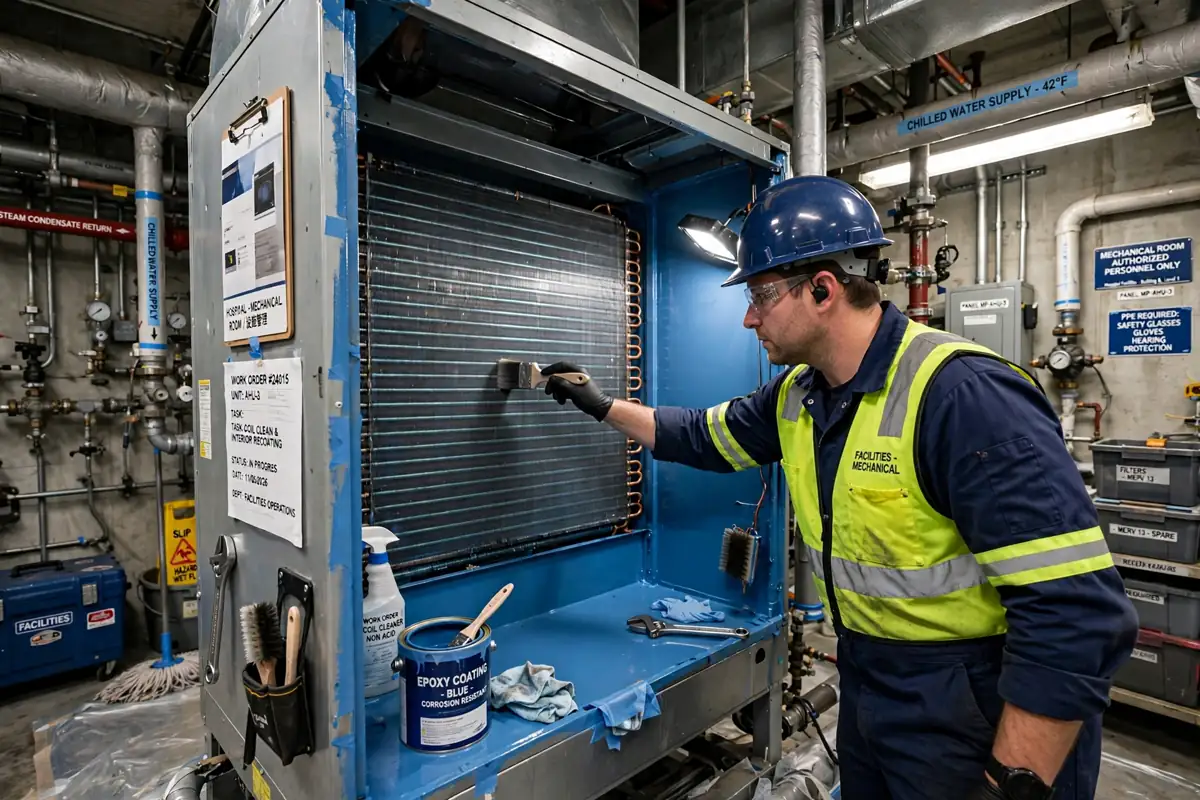
What fails inside an air handler, and why
An air handler lives wet: cooling coils condense moisture all season, drain pans hold water, and interior surfaces cycle between cold and humid for decades. The failure list is predictable — casing corrosion and perforation, degraded internal insulation shedding fibers into the airstream, coil fin deterioration and fouling, drain pan rust and overflow, and air leakage at every degraded seam and door gasket.
In South Florida the cycle never rests: cooling runs nearly year-round, humidity loads are extreme, and coastal air adds chlorides to the corrosion equation. Units in hospitals, schools, and coastal commercial buildings age from the inside while their exteriors still look serviceable — which is why AHU condition is an indoor-air and energy issue long before it is a breakdown.
What a restoration scope actually includes
A complete AHU restoration addresses the unit as a system: deep cleaning and coil restoration or coating, casing repair and corrosion treatment, replacement of damaged internal insulation with closed-cell or coated systems that will not shed or harbor growth, drain pan restoration with protective coating and correct slope, door and access gasket renewal, and sealing of casing leaks that waste conditioned air.
Protective coatings are the core technology: coil coatings that resist corrosion and fouling while preserving heat transfer, and casing and pan coatings that create a cleanable, moisture-proof interior surface. Specified correctly, a restored unit comes back with its interior in better condition — smoother, cleaner, more corrosion-resistant — than the day it was installed.
Restoration versus replacement: the real comparison
Replacement of a large commercial AHU means rigging, structural openings or unit disassembly, duct transitions, controls integration, and weeks of phased downtime or temporary cooling — in a hospital or occupied school, that logistics bill can rival the equipment bill. Restoration happens in place, typically unit by unit during scheduled windows, with the building's other systems carrying the load.
Planning costs for restoration commonly run at a fraction — often a third or less — of full replacement for comparable scope, and a sound restored unit gains years of service with measurably better hygiene and air delivery. The honest limit: a unit with failed structure, obsolete capacity, or a building whose loads have outgrown it should be replaced, and a restoration assessment should say so when the casing or the math no longer closes.
Hospitals, schools, and indoor air quality
In healthcare and education buildings, the air handler is an infection-control and IAQ device, not just a comfort machine. Degraded internal insulation and corroded, fouled wet sections are exactly the reservoirs facility standards tell you to eliminate. Restoration with coated, cleanable interior surfaces is how older units are brought back to a maintainable hygienic standard without a capital replacement project.
Documentation matters in these buildings: before-and-after photos, product data for every coating used inside the airstream, and a scope record that infection-control and facilities teams can file. Work sequencing — containment, off-hours windows, unit-by-unit scheduling — is planned with the facility, and in hospitals coordinated with ICRA requirements where they apply.
Energy and performance recovery
A fouled coil and a leaking casing tax a building twice: heat transfer drops, so compressors and chillers work harder; conditioned air escapes into mechanical rooms and shafts instead of reaching the space. Coil restoration and coating, casing sealing, and correct drain function recover performance the building has been paying for without receiving.
Set expectations in measured terms: pressure drop, coil approach temperatures, and leakage are checkable before and after. A restoration proposal for a critical facility should include the baseline readings it intends to improve — the same discipline as a roof moisture scan, applied to the mechanical room.
Signs this service is the right call
- Corrosion, rust staining, or perforation inside the AHU casing or drain pan
- Internal insulation that is damaged, delaminating, or shedding into the airstream
- Coils that are fouled, fin-damaged, or losing capacity despite cleaning
- Drain pan overflow, standing water, or recurring microbial findings in the unit
- Air leakage at casing seams and access doors wasting conditioned air
- A capital plan facing AHU replacement mainly for interior deterioration
How the work runs, step by step
- Unit condition assessment. Interior inspection with photos: coils, casing, insulation, pan, doors, and leakage — with baseline performance readings where the facility needs them.
- Scope and product submittals. Every coating and insulation product documented for airstream use, submitted to the facility before work begins.
- Cleaning and surface preparation. Coils and casing cleaned, corrosion treated, failed insulation removed under containment appropriate to the building.
- Restoration and coating. Coils, casing, and pan restored and coated; insulation replaced with closed-cell or coated systems; gaskets and seals renewed.
- Verification and records. After-photos, product records, and performance checks filed with the facility for compliance and capital planning.
Planning costs in South Florida
| Scope | Planning range | Notes |
|---|---|---|
| Single AHU restoration | Priced per unit | By size, condition, access, building type |
| Coil coating only | Priced per coil | For sound units needing corrosion protection |
| Multi-unit restoration program | Priced per building / phase | Sequenced unit by unit around operations |
Ranges are planning figures from published market data, not quotes. Your number depends on the moisture scan, deck condition, detail count, and access. Get the full breakdown in the commercial roof coating cost guide.
Frequently asked questions
How long does AHU restoration extend a unit's life?
A sound air handler restored with coil, casing, pan, and insulation work commonly gains many additional years of service — often cited in the 10-plus year range for units whose structure and capacity remain right for the building. The assessment verdict rests on casing integrity and whether the unit still matches the load, not on age alone.
Is AHU restoration worth it versus replacement?
Where the casing is sound, restoration typically costs a fraction of replacement — often a third or less — and happens in place without rigging, structural openings, or weeks of temporary cooling. Replacement wins when capacity, controls, or structure have genuinely run out. A credible assessment prices your unit both ways.
Can restoration be done in a hospital without disrupting care?
Yes, with the planning hospitals require: unit-by-unit scheduling, off-hours windows, containment, and coordination with infection-control (ICRA) procedures. Product submittals for everything used in the airstream are provided in advance. This is precisely the building type where in-place restoration beats replacement logistics.
What products are used inside the airstream?
Coil coatings engineered to protect fins without meaningfully reducing heat transfer, and casing and pan coatings that cure to hard, cleanable, moisture-proof surfaces. Internal insulation is replaced with closed-cell or factory-coated products that do not shed fibers. Submittals with product data should be part of any proposal — ask for them.
Does AHU restoration improve indoor air quality?
It removes the main interior reservoirs: fouled coils, corroded pans holding water, and degraded fibrous insulation. Restored interiors are smooth and cleanable, drains run correctly, and the unit stops being a source. IAQ gains are verified the practical way — visual condition, drainage function, and the facility's own sampling where it is performed.
How long does it take to restore one air handler?
A typical commercial unit runs several days to about a week including cleaning, preparation, coating cure windows, and insulation work, depending on size and condition. Multi-unit buildings are sequenced so only one unit is down at a time, scheduled around the building's critical periods.
Can coils be protected before they deteriorate?
Yes — coil coating on newer units is preventive: it shields fins from the corrosion and fouling that destroy capacity in coastal and high-humidity service. It is the cheapest coil insurance available in South Florida, and it is far easier to coat a clean coil than to restore a deteriorated one.
Related: HVAC duct restoration · commercial roof coatings · building waterproofing · service areas · who we serve